


Before you sit down, before we talk, before anything, I want to say something to you.
Woezor.
Pronounced [Way-Zohn], Zohn sounding like John but the n is very soft and nasally.
In Anlo Ewe, my mother tongue, this is how we greet someone who has just arrived. It means: you have traversed, you have walked, you made it here. The word itself, the very first thing out of our mouths, is an acknowledgment that getting here cost you something. Time, energy and thought. We do not take any of that for granted.
If you came with others, the greeting opens wider. Miawoezor, pronounced [Mia-Way-Zohn], meaning all of you, every one of you who traversed. Seen individually, welcomed collectively.
In my last essay I told you about Amedzro, the person we crave, the visitor we were already hoping would come. Woezor is what happens the moment that person actually walks through the door. The craving has been answered. Now the welcome begins in full.
And it is more elaborate than you might expect.
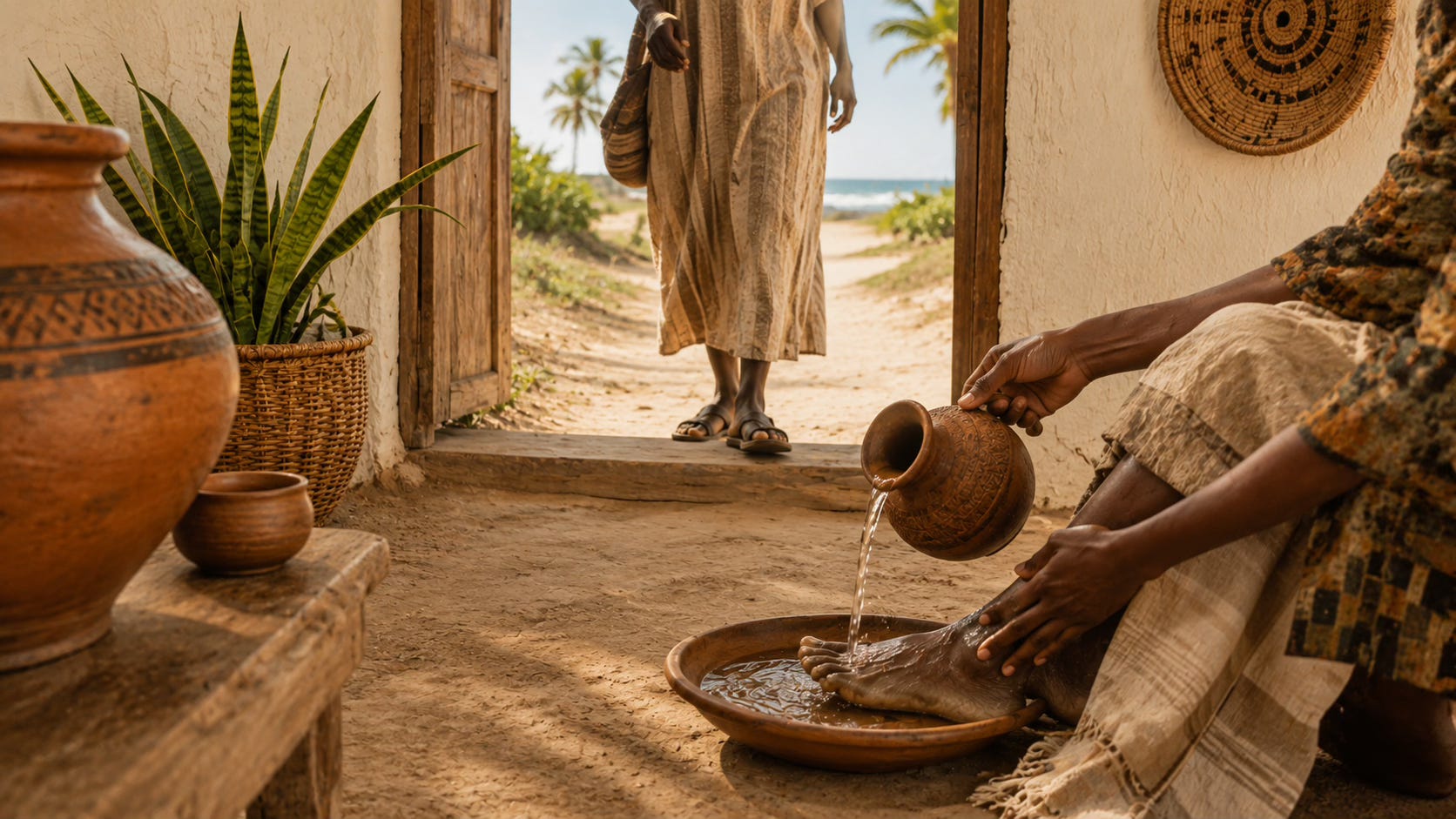
First there is water, not to drink yet, but to wash your feet. If you walked any distance at all, especially along the sandy paths of coastal Ghana, your feet carried the evidence of that journey. We acknowledged the journey with Woezor. Then we cleaned it from your feet. You arrived. Now you rest.
Then comes the drinking water and this is where it gets interesting.
Even if you are not thirsty, even if you drank a full bottle of water five minutes before walking in, you take a sip. It is expected. Not as a performance, but as a statement. By accepting the water you are telling your host: I trust you. You are saying without words that you believe the cup contains nothing harmful, that you have come in good faith, that you are glad to be here. And the host, watching you accept, feels something too. A quiet reassurance that you mean no harm, that this visit is safe, and the welcome was right to be given.
Two people. One cup of water. An entire negotiation of trust, conducted in silence.
Now the greeting.
What follows is unlike anything you will find described in most books about African culture, because it is not a greeting in the way Westerners typically think of one. It is closer to a structured ceremony, a gentle and deliberate period of conversational turns, if you can imagine such a thing. The guest and host take turns leading, each asking after the other’s family, children, work, health, and after each question the other responds. When one side finishes, they add one word, ɛyooo, and a brief deliberate pause. That single word is the signal of a handoff. You have to be attentive to notice it. Now the other leads. When both sides are complete, they shake hands. The greeting is closed.
If all is well in the house, the host will then say something that has always moved me. We are at peace here. You are the one who traversed. The floor is yours.
The guest who traveled gets to speak first. The effort of the journey earns that right.
If the matter is serious, if what the guest has come to say carries weight, someone else may be called into the room. A witness. Someone to hold what is about to be said. Nothing important happens without being witnessed.
None of this is mandatory but it is usually expected. A guest can always politely ask to skip the full ceremony and just talk. A simple good evening is enough and it is accepted graciously. But even in the abbreviated version, notice what remains. Each person in the room is greeted individually, not a general wave at the group. If it were morning it would sound like this. Ndii nami kɛɛn, pronounced [Indee Nahmi Kehn], the Kehn rhyming with a stretched out bend. This greeting translates directly as good morning to you all, severally. Each face acknowledged. Each person seen.
That is the thread running through all of it. Woezor, the foot water, the drinking water, the greeting ceremony. Every single element is saying the same thing in a different language.
You matter. Your presence here is not ordinary. We noticed you came.
And when you say Woezor to someone, they answer you. The response is yooo or ɛyooo, the same word of affirmation you heard earlier in the greeting ceremony, now turned outward. There it closed one side of the exchange between host and guest. Here it receives the welcome itself. I acknowledge what you said. If the traveler wants to add a flourish, they say mɛ zor dɛ mianu, which translates literally to I have traversed up to you all. The visitor’s declaration back to the host. I came here intentionally. I made this effort because you matter to me. The connection runs both ways.
The exchange is complete only when both voices have been heard. That is the beauty of it. Woezor is never just one person speaking. It is always a conversation.
So I want to ask you. How does arrival look where you come from? Is there a word, a ritual, a gesture, however small, that says to the person who just walked through your door: I see what it took you to get here?
Two weeks from today, I will bring you a word that stings. The kind that travels further than the person it was meant for. Subscribe so it finds you when it arrives.
Woezor, my friend. I am glad you traversed.
Yao.