


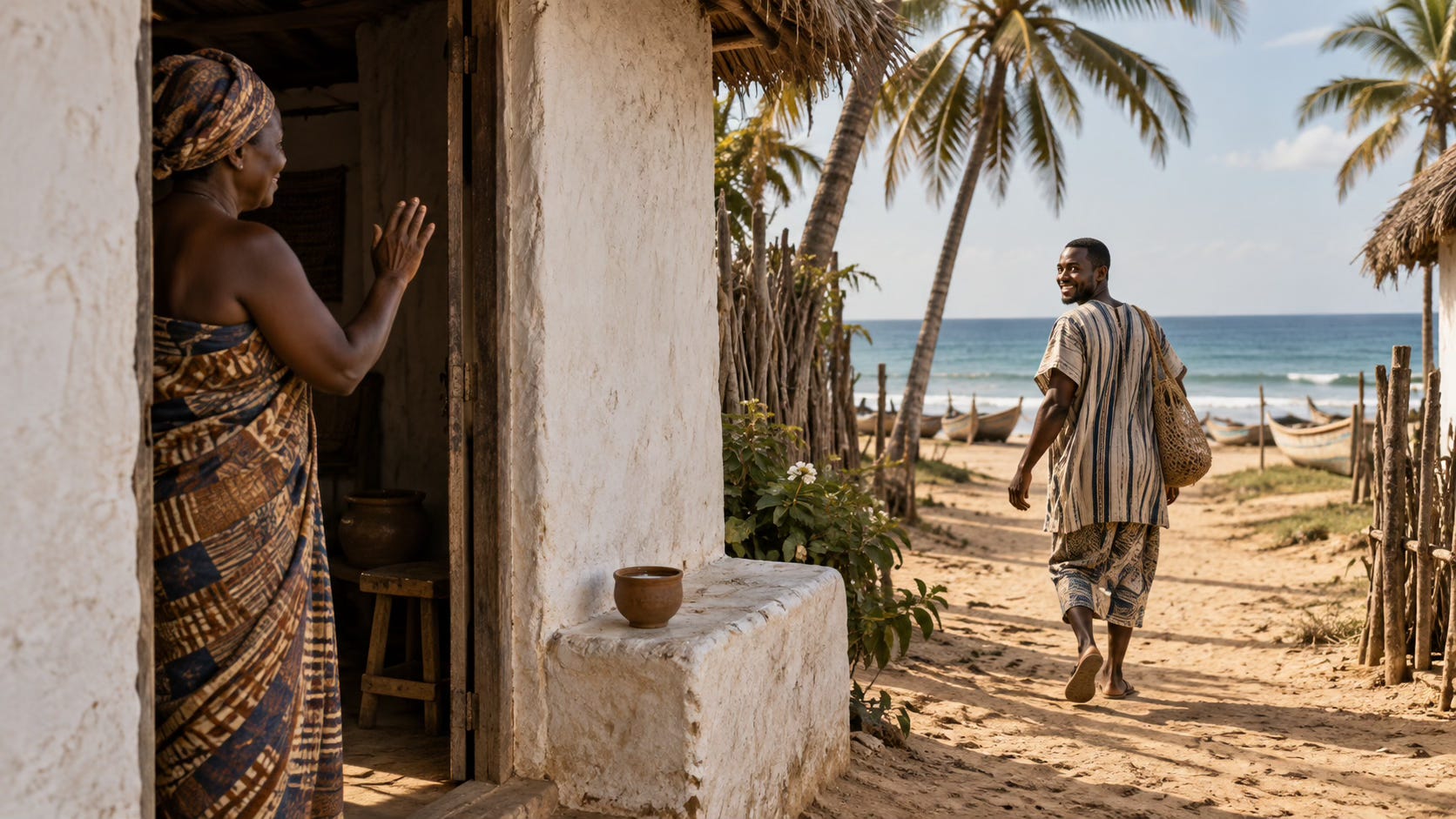
I want you to sit with that for a moment before I explain it, because it is not a small thing. It is not a quirk of translation or a gap in the language that was never filled. It is a deliberate reflection of how my people, the Ewe of Ghana, understand human connection. We do not say goodbye because we do not believe in it. We never have.
When a guest leaves, when you walk someone to the road and watch them go, what you say in Ewe is ɛmɛgbɛ, meaning afterwards, or later on. If you know you will see them soon, you say miagadogo, we will meet again. The distinction matters. One holds open the near future. The other holds open all of time. Both refuse to close the door.
There is even a phrase for the ordinary hours of a single day. If you see someone in the afternoon and evening has not yet come, you might say Ɛzamɛdowo, night has not fallen yet. What that phrase is really saying is this: the day is not over. I cannot rule out seeing you again before it is. Therefore, I will not pretend this is the end of the day.
I used to hear people at retirement parties in the west say “goodbye is not forever,” and I would think to myself; for us, it is not even a word. Goodbye suggests finality. It suggests a door closing and a key turning. We simply do not build doors like that.
This same philosophy carries into conversations. When we leave something unfinished, we say Miagayidzi, we will pick it up where we left off. We do not end conversations; we pause them. Because ending a conversation is like ending a visit or a relationship, requires a kind of goodbye we do not know how to say.
Now you might think that death, of all things, would finally force the word out of us. It does not.
When someone we love passes, we believe they have gone ahead. Not away, ahead. We pour libation, speak their names and call on them during the hard decisions; the ones that keep you up at night, asking for steadiness and clarity. It was not unusual in Ewe households for prominent family members to be buried at the front of the house, or within the compound itself. Close enough to be consulted, close enough to still belong.
And when we say farewell at death, we say, “Hedenyue,” which translates as, “Go on and arrive safely, wherever you are going.” Not goodbye. Arrive safely. As though the journey continues and we expect a report.
Because we do.
We believe in reincarnation. We believe that some of us are our ancestors, returned. I am one of those people. I was the first male grandchild born after my grandfather passed, and my family has always held that I am him, come back. My mannerisms carry his. My demeanor echoes something older than my own years. I have never found reason to argue with it.
In my next essay, I will tell you about my grandfather’s name, and what it means. That essay has been living in me for a long time.
For now, ɛmɛgbɛ. Later on. We will meet again.
Tell me, does your culture believe that those who leave are ever truly gone? Is there a word, a ritual, a grave in the front yard, that keeps the conversation open?
Ɛmɛgbɛ,
Yao.