

My great grandfather had a philosophy, and it went like this.
“Gakpleazi mɛno kɛvi mɛ o, nɛ ga mli ko kɛ aziaa gbã,” [Ga - kpleh - azhi - meh - nor - kehvi – meh – o, Neh - ga - mlee - ko - keh - Azhiaa – gba] which literally translates, “A metal and egg cannot be in the same small sack, if the metal rolls, the egg will break.” To wit, you cannot put an egg and a piece of metal in the same small sack. If I may ask, is there a way to achieve that?
What he was saying was not about sacks, metals or eggs. He was saying that life is a balance between strength and tenderness, and that balance is not optional. It is the condition of survival. You need the firmness of metal. You need the fragility of the egg. Held together carefully they are two necessary things. Held together carelessly, one destroys the other. The art is in how you carry them both.
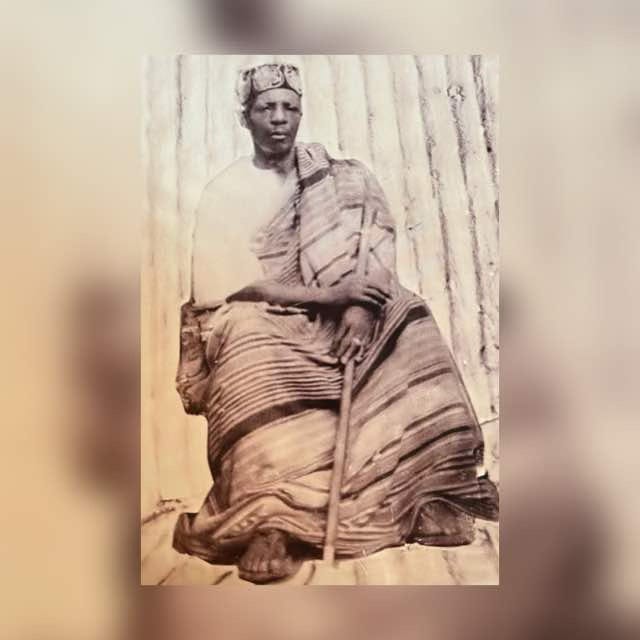
That philosophy was so central to who he was that it became his name. Or rather, it became the adjective that qualified his actual name, Amuzu Amoo – zu]. Over time, the philosophy compressed itself into a single word, “Gakpleazi,” [Ga – kpleh – azhi] and attached itself to the man who lived it most visibly. My maternal grandfather, his son, carried that name forward with such conviction that he became inseparable from it. The man in the photograph above is my grandfather.
His brothers and cousins, watching what a name could do for a man’s identity, adapted their own adjectives. One became Amuzu-Gbogboga [Amoo – zu, Ggboh-Gboh-ga!]. Each man, sharing the same name, found his own qualifying word. A small act of self-definition that I find quietly magnificent.
My grandfather was a herbalist. Not in the casual sense of the word. He cultivated a garden of wild plants sourced deliberately from the bush, each one selected and tended for its purpose. When a child was brought to him suffering from convulsions, he would walk into that garden, choose the right plants from memory and knowledge, grind them by hand, and administer them in a precise sequence. His methods worked. The child’s body would expel what was threatening it and the child would recover. In a time before hospitals were within reach of most families in coastal Ghana, he was what stood between a sick child and the worst outcome.
He was also a man of considerable standing. A cattle rancher and crop farmer, who also owned fishing nets and rented them out to fishermen along the coast. And above all of that he held the role as owner of the stool of his clan. In Ewe tradition, the stool is the seat of a traditional ruler, the physical and spiritual symbol of leadership. The owner of the stool is its ultimate custodian, the one responsible for keeping the ruler accountable for maintaining the integrity of traditional governance. It was the most demanding application of his philosophy. You needed the strength of metal to hold power in check. You needed the care of an egg to do it without breaking what you were protecting.
Back then to be called Dumɛga [Doo-meh-gah] was not a title given freely. It was not a courtesy extended to any man who had grown old or carried a respected surname. It had to be earned, through genuine and visible contribution to the life of the town, through the kind of service that people remembered and named out loud. My grandfather earned it the way his own name said he should, by holding strength and tenderness together long enough and consistently enough that the community had no choice but to acknowledge it. Communities brought their disputes to him and he mediated. He also arbitrated. He held the tension between opposing sides the way his father’s philosophy said to hold metal and egg, firmly enough to keep them together, gently enough that neither destroyed the other.
His standing was such that when Dufia Joachim Acolatse I, [Doo-fia - Joachim - Akor-lah-chey - the first], the traditional ruler of Kedzi [Keh-Jee] who reigned from 1865 to 1927, passed away, my grandfather was among the elders summoned to Kedzi [Keh-Jee] to help plan the grand funeral. It was a role reserved for men of genuine consequence. He spent several days there, away from home, fulfilling that duty. During those days, back in Tegbi [Teh-gbee], my grandmother gave birth to a daughter. The exact date of birth of that daughter was not captured at birth which wasn’t unusual back then. When the date of her birth was needed, it had to be traced to the particular timing of events surrounding the funeral which then settled the contention once and for all. It became the fixed point by which everything else was measured.
They named her Adzo [Ah-Jo!]. In Ewe, Adzo [Ah-Jo!] means female born on Monday. She carried the day in her name. She did not need a record, she was the record. My grandmother remembered clearly it was either the day of, or the immediate Monday after the passing of the great chief. He was Dumɛga Amuzu-Gakpleazi of Tegbi [Doo-meh-gah, Amoo – zu, Ga – kpleh – azhi]. And even his absence from home during one of the most significant moments of his family’s life was in service of something larger than himself. Metal and egg again. Every time.
He was not a Christian, yet he led the elders of his larger family to donate the land on which the Catholic church and school were built in his hometown of Tegbi [Teh-gbee]. That land still holds those buildings today. He gave it freely with no conditions, without belonging to the faith. Metal and egg again. The strength to lead and the tenderness to give to something beyond himself.
As fate would arrange it, a great grandnephew of his whose great grandmother was my grandfather’s older sister, today, serves as a Catholic Bishop in the Volta Region of Ghana.
He was not a Christian, yet his family produced a Bishop.
My older sister carries a similar truth alongside me. She is believed to be our great aunt reincarnated, and that great aunt was older than my grandfather, just as my sister has always been older than me. The relationship between them mirrors the relationship between us, in age, in dynamic, in the particular way we have always effortlessly and unexplainably understood each other.
My mother says we reincarnated from the same womb, the two of us, just as our grandparents did before us. She has never said it with any drama. Just the quiet certainty of someone reporting what she has always known to be true.
I have told you in a previous essay that I was the first male grandchild born after my grandfather passed, and that my family has always believed I carry him forward. Some of his mannerisms arrived with me before I knew enough to have developed them on my own. Some of his demeanor has always felt less like personality and more like memory.
Those are some heavy shoes to fill for the reincarnated, me. No pressure.
The first twelve weeks in a new job are when a person decides, usually without knowing they are deciding whether they belong there or not. I was the one responsible for that window, at a company I used to work at.
I have been in those rooms. Week after week, watching someone find their footing or lose it, and having to decide in the moment whether what they needed was the firm word or the open hand. Too much edge and something closes in them. Too little and the habit takes root and becomes harder to shift later. My superiors and colleagues sometimes thought I was too easy. My direct reports sometimes thought I was too hard. I was trying to be both at once, which is not a compromise. It is the thing my grandfather’s name describes.
Gakpleazi is not the balance you find. It is the weight you carry while you are still looking for it.
Share with me, does your family carry a philosophy the way mine carried metal and egg? Is there a belief, a saying, an image so precise and so true that it eventually became someone’s name? And if you were to distill your own life into a single image that honest and that clear, what would it be?
You can share that in the comments section of this essay and let’s continue that conversation.