


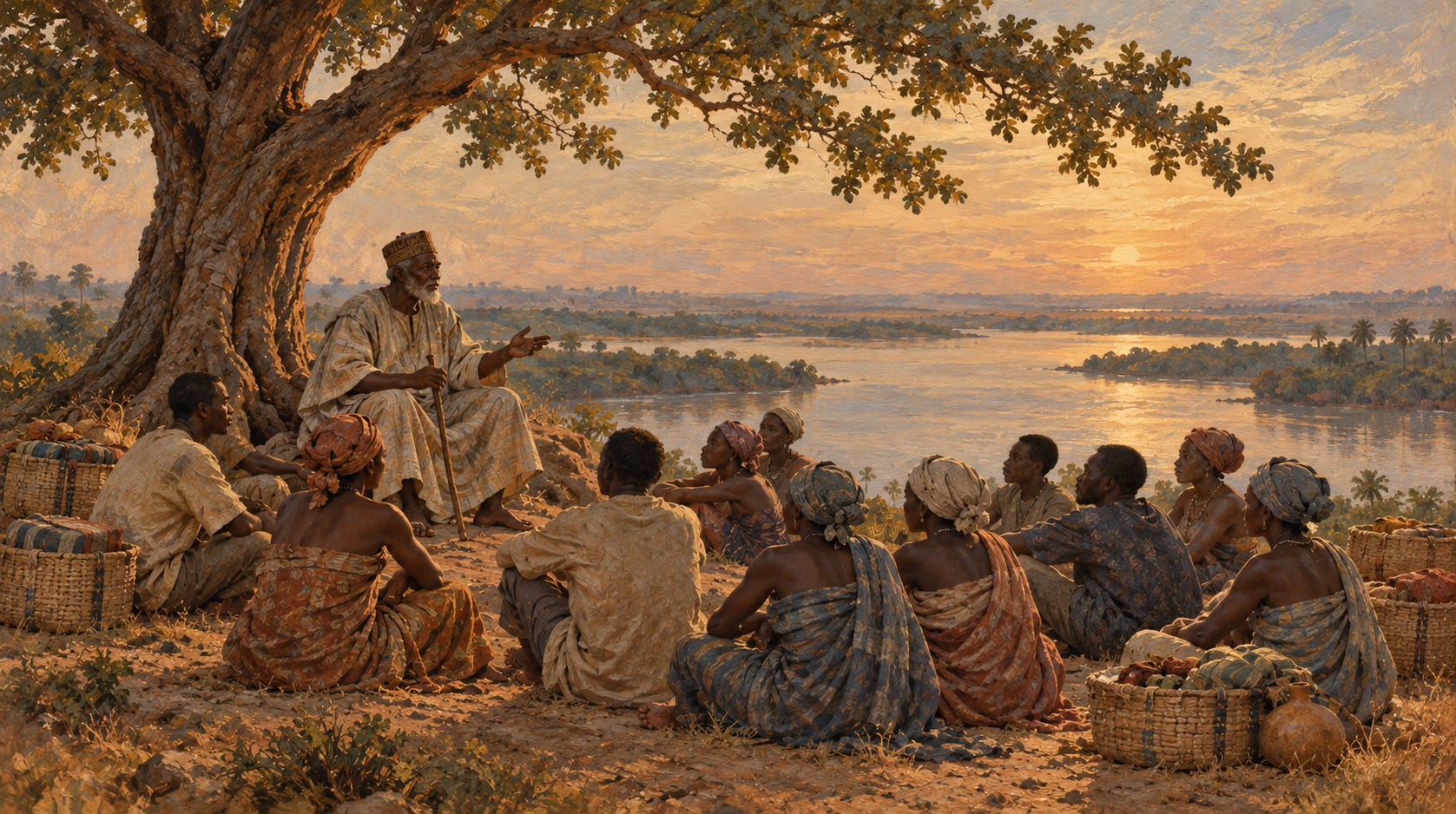
A note before we begin: this is oral history. It came to me through family, through telling, through the sort of knowing that does not live in Libraries. Scholars may find gaps. That is not what this is for.
Where the Ewe People Begin
Before there was an Anloga [Ang-lor-gah], before there was a migration, before there was a wicked king or a wise old man or a wall weakened by wash water, there was a people moving through history the way water moves, finding the lowest point, following the available path, settling where the land allowed.
The Ewe people carry two origin stories and hold both without needing to resolve them. One traces the line backward through West Africa, through the Niger basin, through Egypt, all the way to Israel area. The other points to the great empires of the Sahel, Mali and Songhai, and traces a long arc eastward through the desert fringe, down toward the Niger, then westward along the coast. Family oral history places the starting point further east still, in the region of present-day Ethiopia, with the journey continuing through Nigeria and into Yoruba land before turning west. What both versions agree on is a long arc through West Africa that passes through the area around Ile-Ife and Oyo in what is today southwestern Nigeria, among the earliest traceable points of Ewe settlement in recorded history.
It was somewhere in that Yoruba land, and through significant stops at Ketu [Keh-two!] and Dogbo [Dough-gbo] along the way, that the people encountered something they would carry with them for the rest of the journey, not as luggage but as practice. A palm, bearing inedible fruit, of no use to hunger, but understood to hold real spiritual power; a means of reaching the Supreme Being through prayer and offering. They called it Hudɛ [Hoon- deh]. They did not leave it behind when they moved on. It traveled with them into Notsie [Nor-chiey], and from Notsie [Nor-chiey] it traveled with them again, all the way to the Anlo [Ang-lor] coast, where it is still called upon today. What it became in my own family’s hands deserves room of its own, and I will return to it properly in the next essay. For now it is enough to know that some inheritances are not land or title. Some are practices, carried on foot, generation after generation, until they simply become how a family prays.
The result of that long migration is a language and a people that today span four nations. Ewe, in one dialect or another, is spoken across Ghana, Togo, Benin and Nigeria. It is a transnational language that predates every border it crosses. As the people settled and resettled across these territories, dialects shifted, some slightly, some deeply, the natural consequence of distance and time and the particular shape of each new home but the thread remained and there is mutual intelligibility. The names remained. In all these places, people named their children after incidents and aspirations so that a name, when translated, reads not as a word but as a sentence. That tradition of meaning-carrying names connects Ewe communities across four countries and echoes in certain Nigerian naming traditions as well. It is one of the quiet signatures of a shared origin.
The Kingdom They Had to Leave
The particular migration that defines the Anlo Ewe people began in a fortified town called Notsie, in what is today the nation of Togo.
Notsie was the seat of a king named Agorkorli [Ah-gor-kor-lih!]. Agorkorli [Ah-gor-kor-lih!] was powerful in the way that unchecked power always becomes powerful through fear, cruelty and the systematic destruction of any possibility of resistance. The kingdom walls were thick earthen structures, solid enough to contain an entire people. Purposefully, Agorkorli [Ah-gor-kor-lih!] used them that way. His subjects were subjected to punishments designed as much to humiliate as to harm. They were ordered to weave ropes from clay. They were made to knead mud filled with thorns using their bare hands. Every attempt to escape was met with consequences brutal enough to discourage the next attempt.
The walls kept them in. The punishments kept them afraid and the king’s watchfulness kept them from organizing. So, he believed.
The Old Man and the Plan
Among the people of Notsie was a group led by an elderly wise man named Torgbui Wenya [Tor-gbi, wherh-nya] “wh” is very soft, and the rest of the name slightly nasal. He was not young and fast but he understood something that the king’s cruelty had overlooked. He was the king’s foil. He demonstrated that patience, applied with precision, could do what force could not. His instruction to the women of his group was so simple it was almost invisible; “When you wash, when you clean, and when you pour away any water at all, pour it here. On this section of the wall. Only here. Every time.” No one watching would see anything alarming. Women’s pouring of waste water near a wall was an ordinary daily act. However, water, given enough time and enough repetition, does not negotiate with stone or earth. It simply persists until the wall has no choice but to yield.
They followed his instruction without deviation. Day after day, season after season, the water went to the same place on the same wall and the wall, slowly, without announcement, began to soften.
The Night of the Full Moon
When the night came, it came with a full moon. Enough light to move by. Enough darkness to disappear into.
The wall gave way at the chosen section with relative ease, exactly as the old man had calculated. The breach was narrow, it was a deliberate choice. Wide enough to pass through. Not wide enough to look like an escape route.
Then came the final instruction, the one that still arrests me every time I think about it. They walked out backwards. Every person who passed through that breach turned themselves around and walked away from Notsie, facing it so that any tracker who followed their footprints in the earth would read the story in reverse. The prints led toward the wall, not away from it. The kingdom’s people appeared to be arriving, not fleeing.
They carried only what they could bear without slowing down. They left behind everything else and walked backwards into the dark, into the unknown, into freedom, until they had gone far enough that tracking was no longer the danger and they could turn around and face the direction they were actually going.
The Journey Along the Coast
They moved in groups and subgroups, Torgbui Wenya [Tor-gbi, wherh-nya], at the center with his lieutenants carrying responsibility for each cluster of people. They crossed from what is today Togo [Toe-goh] into what is today Ghana, following the coastline, that ancient reliable road of sand and water that has guided migrations since people first learned to follow the horizon.
As they moved, people settled. The coast offered what they had always known, fishing, trading the particular rhythm of life between land and water. Towns formed where people stopped and decided this was enough, this would do, this was home.
The names they gave these places were true in the way only a people paying close attention can make names true.
Kedzi [Keh-Jee]. On top of the sand. A settlement perched on a great white sandspit, bleached and bright under the coastal sun, exactly as its name described. It was here that Dufia Joachim Acolatse I would reign, from 1865 to 1927, a chief of sufficient stature that my own grandfather would be summoned to help plan his grand funeral. As you may have read in my last essay, “Gakpleazi”.
Keta [Keh-tah], Head of the sand, where the land met the water at its most definitive point. Keta would grow into one of the most significant towns on the Gold Coast. A commercial hub, a seat of trade, and eventually a place whose name carried weight far beyond its shoreline.
Tegbi [Teh-gbee]. Carries a different kind of name, a person’s name rather than a description of land. Among the matriarchs traveling with the group was a woman called Mama Tegbɛ [Mama, Teh-gbeh]. At some point along this stretch of coast, she could go no further. She was tired. She was respected enough that when she said, “This is where I stop,” the people traveling with her stopped too. They settled there, around her, and the place took her name. Of all the towns founded along this migration, Tegbi [Teh-gbee] is the only one I know of named for a woman who simply could not walk any further, and was loved enough that nobody asked her to.
Woe [Woay!]. Whuti [Whoo-tih] “wh” is very soft. Each one a settlement, each one a decision made by a group of people who looked at a particular piece of coast and recognized something in it.
Another interesting name of a town is, Tsiamɛ [Chia-meh], translates as inside the water, because it was almost literally that. Surrounded by the waters and marshes the great Keta Lagoon on nearly every side, close enough to an island that the name was simply the truth stated plainly.
The land they were settling was extraordinary. To the south, the waters of the Gulf of Guinea stretched toward the Atlantic horizon, a coastline of remarkable power and beauty. To the north, the Keta Lagoon, one of the largest lagoons in West Africa, a body of water that was not merely a landscape feature but a living economy; fishing and fish trading. The daily work of people who had always known how to read water.
It was into this rich, ecologically diverse world that the Anlo Ewe people arrived and recognized themselves.
The Old Man Folds
But the journey had taken everything from Torgbui Wenya.
He had carried his people out of captivity with nothing but patience and wit. He had watched them walk backwards to freedom. He had guided them through Togo and into Ghana, past the settlements forming along the coast, past the places finding their names, past the people finding their homes and then, he stopped.
He looked at where he was and said, simply, Mɛ nlɔ [Meh-nglor]. translates as, I have folded.
In another man that might have been to surrender. In Torgbui Wenya it was a declaration. He had brought them as far as a human being could be asked to bring anyone. The fold was not defeat, it was completion.
Absolute completion because of who he was. Gleaning from what he had done and what he represented to every person who had walked backwards out of Notsie behind him, no one could go further. His stopping made the stopping permanent. The place where the old man folded became Anloga. “Anlo”, to fold. “Ga” big or grand. The grand fold. The final settlement. Home!
The Stool, the Sacrifice and the Man Who Could Not Be King
But a king without his stool is a symbol without its power. And the Anlo people had left theirs behind in Notsie.
The stool in Ewe tradition is not furniture. It is the seat of authority, the physical and spiritual vessel through which a traditional ruler derives legitimacy. Without it, leadership is a title with nothing underneath it. They needed it back. But Agorkorli’s terms were not simple. Word came that the stool would only be returned if the people brought him the arm of the old wise man, the very elder who had led them out.
And so, an emissary had to be sent to Agorkorli. But then this was no ordinary errand. The journey back to Notsie was treacherous, a road through uncertain territory that required not just a messenger but someone to travel alongside him, clearing the path, fighting off animals, standing between the mission and whatever might try to stop it. It was a journey for the brave. Everyone understood that.
Torgbui Wenya, the wise old man at the heart of this clever migration, turned first to his sons. None of his wives would allow it. The risk was too great. The road, too dangerous and a mother’s refusal in that moment, was absolute.
It was the old man’s sisters who would not accept the alternative.
They could not bear the thought of disgrace settling on their brother’s name, on the family’s name, on the name of the people who had come so far. Hence, they looked to their own sons. One of the sisters had twin boys and a third son born immediately after them. In Ewe tradition, the child born directly after a set of twins carries the name Doe [Dough]. This Doe [Dough] was a hunter of extraordinary reputation. He was noted to have said that when he heard wild animals roaring in the wild he was restless until he had silenced them. “Unfinished business,” he called it. He could not leave a thing incomplete.
Doe volunteered without hesitation.
A cousin, Adelaja, [Ah-derh lah-jah] “jah” sounding slightly nasally, the son of another of the old man’s sisters, joined him. The two of them were nephews to Torgbui Wenya, maternal cousins to each other, and they set out together toward Notsie to face a king who had every reason to want them dead.
Nonetheless before they left, something else happened. Among the people who had joined the group along the migration, a man whose name history has not preserved, who had not been part of the original escape from Notsie but had found his way to them on the road, a man who appeared frail, perhaps carrying some disability, gave something no one had asked of him.
He gave his arm.
It was severed and prepared for presentation to Agorkorli as proof that the old man’s wrist had been delivered as demanded. This unnamed man did not travel to Notsie. He stayed behind. And he likely did not survive what he had given. The wound or the complications that followed, would have been beyond what any treatment available to them could address. He gave it for a people he had joined along the way, not a people he had been born into.
History did not record his name but the stool came home because of him.
When Doe and Adelaja [Ah-derh lah-jah] arrived before Agorkorli and presented the arm, the king was surprised. He had not expected them to follow through. He released the stool.
But Agorkorli was not finished.
Through a spiritual invocation placed over the stool at the moment of its release, he declared that no one who had ever taken a life, whether of man or wild animal, could sit upon it as king. He knew exactly what he was doing. He could not stop the stool from leaving. So he ensured that the person most deserving of the throne it conferred would be disqualified from sitting on it.
Doe, the hunter who had silenced every animal that roared in the wild, who had fought skirmishes and come through them, who had volunteered without hesitation for a journey no one else would take, could not be king. The invocation made it impossible.
Torgbui Wenya’s disappointment was real and recorded in the oral history. He had wanted Doe on that stool. The bravery of the mission had earned it. But the spiritual condition placed on the stool by a wicked king in his final act of malice held, and Doe, understanding what it meant, removed himself from consideration without protest.
The kingship, or Awoamefia [Ah-war-meh-fia] passed to Torgbui Wenya’s own sons, the first being Torgbui Sri. Adelaja, who had made the journey alongside his cousin Doe, entered the rotational succession as well, his line eventually producing a second king, Torgbui Adelaja II, who centuries later would become the classmate, relative and closest friend of the late Col. Andreas K. Amuzu (Rtd), [Ah-moo-zoo] my maternal uncle. The two of them joining forces in the early to mid-1960s to formalize Hogbetsotso into the festival it is today. The circle that began with the stool’s retrieval was closed, generations later, by the direct descendants of the men who retrieved it.
Doe settled in Tegbi. The town named for a woman who could walk no further. He was of the Liké [Lee-kay] clan, and he carried with him into that settlement the full weight of what he had done and what he had been denied. His descendants remained. They are still there. Tegbi, Vui [Voo-wih] and the surrounding areas.
I am one of them.
And recently, a court judgment in Ghana ruled that the descendants of Doe may enter the rotational succession to the kingship of the Anlo people. The invocation placed by a wicked king on a stool retrieved at great cost is not, it turns out, the final word.
It never was.
The Nation They Built
Having escaped one king’s absolute power, the Anlo people made a deliberate and permanent decision about the kind of governance they would build for themselves.
No single overlord. Never again.
Instead they organized themselves into a nation of 37 towns, governed through 17 clans, each with its own traditional ruler and its own stool, its own internal norms and its own identity. Above them all, a Paramount King, the Awoamefia, who held the highest authority but not the kind of unchecked, wall-building, thorn-mud-kneading authority that Agorkorli had wielded. The structure was designed to distribute power, to ensure that no single person could ever again do to the Anlo people what they had escaped.
They had not just fled a wicked king. They had studied him and built their freedom in the precise shape of everything he was not.
The Anlo Dukor [Ang-lor, Doo-core], the Anlo Nation, was born not from conquest but from the long memory of people who knew exactly what they were determined never to become again.
A People Who Chose Wit Over War
Let me be precise about something. The Anlo people were not without warriors. Each of the seventeen clans maintained its own designated warrior, trained and ready. However, the warrior was the last resort, not the first instinct. They were, in the most accurate sense of the phrase, reluctant warriors. They did not go looking for confrontation. They saved that capacity for the ultimate moment when every other option had been exhausted.
In other words, my people are warm and slow to anger. Just don’t test that capacity.
Again, because they almost always found another option first, that moment rarely came.
But friendship was not passivity, it was as mutual as it was strategic. When their fishing waters, the source of their livelihood and territorial boundary, they had chosen and named were encroached upon, the Anlo fought. There are accounts of conflicts and at least one significant confrontation over control of the coastal waters. They were not defending pride or conquest. They were defending what they had built. That distinction mattered to them. A people who chose wit over war, still know how to wage one. They simply reserve the knowledge for what is worth it.
Nowhere is this more evident than in their relationship with the Ashanti Kingdom. The Ashanti were among the most formidable military powers in West African history, a Kingdom that fought and won several battles and wars. Yet, between the Ashanti and the Anlo Ewe, there was never a battle. Not one.
What there was instead was friendship, deliberate, structured and mutually beneficial.
Emissaries traveled back and forth between the two people. Sister towns were established in each other’s territory. In Kumasi, the great Ashanti capital, a settlement was designated Anloga, a place where Ewe people were actively welcomed and encouraged to put down roots. In Anloga, land was set aside for the Ashanti in return, though they did not ultimately come to settle as imagined. The gesture was made and received and that was enough.
They traded what each had in abundance. The Anlo people brought salt and dried fish/seafood from the coast. The Ashanti brought gold and minerals from the interior. Each had what the other needed and neither needed to fight to get it.
The Awoamefia [Ah-war-meh-fia] would send his spiritual practitioners, men of ceremony and power, to perform on grand occasions in Kumasi, deepening the relationship through culture as well as commerce. It was diplomacy conducted the Anlo way, through presence and gift and the slow accumulation of trust rather than through the threat of force.
One of my uncles, Uncle Jerome Akafia, was nicknamed Prempeh by his community because his bearing and majestic aura so closely resembled those of the great Ashanti king Prempeh I. In our family that nickname was worn as something between a compliment and a term of endearment, the kind only a people with warm relations across cultural lines can make and receive without offense.
Amedzro to Ayevu
But the colonial era brought a different kind of visitor to the Anlo coast. This visitor, was not craved.
They came bearing gifts at first. Mirrors, Gunpowder. The small, bright, useful things that make a stranger seem generous before you understand what generosity is costing you. Gradually, they gained a foothold and their weapons made them appear more powerful than any guest had a right to be. Steadily it became clear that they had no intention of leaving. They were overstaying their Woezor.
The Anlo people, true to everything they had always been, did not reach immediately for their reluctant warriors. They reached first for something sharper and quieter.
They gave the colonizer a name. Among themselves, in their own language, unbeknownst to the colonizer who walked among them, they began calling him Ayevu. “Aye,”[ah-yay] meaning slick. “Avu,” [Ah-voo] meaning dog. Slick dog. A name that captured the nature of what had arrived on their coast with the precision their language had always applied to naming things truly.
Consider what had just happened. In essay one of this series, I told you that the Ewe word for visitor is Amedzro,[Ah-meh-jro] the person I crave. The beloved guest, anticipated and welcomed and fed. Now the same people, applying the same instinct for naming what is true, looked at this particular visitor and named him Ayevu [Ah-yay-voo]. The slick dog. The guest who came bearing gifts and stayed bearing arms.
Same people. Same language. Same instinct for truth. Two completely different names for two completely different kinds of arrival. The naming was not hostility. It was diagnosis.
Having named him, they moved to the next item on what I can only describe as their quiet, methodical progression of resistance.
They fed him cassava. Not ordinary cassava. A particular variety, difficult to distinguish from the common kind but deeply intolerable to the body of anyone who did not grow up eating it. The more the colonizer ate, the sicker he became. Over time, weakened and unable to identify the source of his discomfort, he retreated to his fort and reduced his interactions with the people of the coast.
No weapons drawn, no battle declared and no blood spilled. The same people who had weakened a wall with waste water now weakened an occupier with a root vegetable. The method was different. However, the philosophy was identical.
When the colonizer attempted what colonial powers always attempted, the erasure of identity through naming, by encouraging the local population to take on European surnames, the Anlo people along the Keta coast simply refused. While other populations further west along the coast gradually absorbed colonial surnames into their identities, the people of the Keta and Anloga area held their names. They kept what was theirs quietly, without proclamation and without confrontation. They just did not do it.
That refusal is still visible today in the naming conventions of the area. It is one of the less celebrated but most telling acts of cultural resistance in the history of the Ghanaian coast.
Where My Family Landed
My father’s people settled with the wise old man in Anloga itself, though his mother came from Tegbi, quietly threading both sides of my family’s geography together before I was born.
My mother’s side, the line of Dumɛga Amuzu-Gakpleazi, settled in Tegbi, the town named for a woman who simply could not walk any further and was loved enough that no one asked her to. A town sandwiched between two bodies of water. The ocean to the south and Keta Lagoon to the north. Land held between water on both sides, the way the Anlo people have always understood themselves, between the forces of the world, finding a way to live in the narrow, fertile space between them.
I come from two clans. My father from the Amlada clan. My mother from the Liké clan. I carry both migrations, both settlements, both relationships to that coastline in whatever I am. Mmm… Perhaps it explains something. The way I’m drawn to the ocean without needing a reason. The way entrepreneurship pulls at me with a familiarity that feels older than my own ambitions. The way seafood hits differently, as though my body remembers a diet my conscious mind never chose.
Some inheritances skip the paperwork entirely. They arrive as appetite, instinct and the particular comfort of sitting somewhere near water and feeling, without any explanation that you are exactly where you are supposed to be.
What Remains
The wall in Notsie is reduced to ruins. That brutal kingdom of Agorkorli exists now only in the telling. But the people who walked backwards out of it are still here along this coastline, fishing these waters, and still nominating or selecting and installing their chiefs to stools that were once worth a man’s arm.
Every year, the Anlo people set aside days to remember all of this properly, not as a history lesson but as something closer to a homecoming. That gathering has its own shape, its own rituals, its own name, and it deserves an essay of its own. I will tell you about it next.
For now, this is enough. A people escaped a tyrant by understanding water better than he understood power. They named the place where they stopped after the man who could walk no further. They built their lives and a homeland shaped like everything their oppressor was not. They are still here, still walking, just no longer backwards.
The Anlo did not conquer land to live on. They chose it carefully, named it and stayed.
What have you chosen carefully enough to stay? How did your people come to settle where they are now? Tell me in the comments section, let’s talk.
Ɛmɛgbɛ,
Yao